

Climate Action That Pays: Building a Unified Vision for India’s Youth Climate Future
India’s youth climate movement has come a long way since 2008, passing through waves of national networks like IYCN, student groups, grassroots collectives, and newer youth-led organisations.
My own journey started in 2020 – since then, speaking with people across different generations of the movement, and reading whatever limited history exists on early groups has shown just how much young people’s expectations around climate work have shifted.
The first generation of youth advocates had to fight just to get climate change taken seriously as an urgent political and environmental issue. They focused on awareness, campaigning, and building networks. Over the years, that base evolved into more specialized groups, local movements, and young founders working on clean tech, the circular economy, conservation, and climate justice.
But today, young people are asking very different, much more practical questions:
-
How do I actually make a living doing climate work?
-
How do we build careers that won’t be wiped out by the climate crisis?
-
How do we keep our own neighborhoods safe from extreme heat, water shortages, and pollution?
-
How do we move from just sitting on panels to owning and running real solutions?
-
Most importantly, how do we make climate action pay for itself and matter in everyday life?
Young people no longer just want a seat at the table to be heard. They want to build things, earn a living, and see real results on the ground. We need to catch up to that shift.
COP cannot be our only plan
After nearly thirty years of global climate summits, we have to be honest about where things stand. COPs are useful for diplomacy and international commitments (so called), and tracking how they are moving forward (or backward). However fact is that under this “Global Ecological Colonialism” actual implementation is moving way too slowly.

Even getting governments, to agree on the scale of the crisis runs into political roadblocks – and the communities bearing the brunt of extreme weather simply cannot afford to wait around for global consensus. They cannot keep telling us, to hold out for the next declaration, the next negotiation cycle, or another distant funding promise.
We have to stop waiting for top-down political breakthroughs and start organising bottom-up societal action. That doesn’t mean giving up on global cooperation.
Connecting climate action with India’s jobs challenge
India is dealing with two massive pressures at the exact same time:
-
Millions of young people need decent jobs, practical skills, and a way to earn a living.
-
Extreme heat, water scarcity, and erratic weather are actively destroying existing livelihoods.
For too long, policymakers and organizations have treated these as two separate problems. What happens if we use one to solve the other? Climate action could easily become one of India’s biggest engines for local jobs, small businesses, and community resilience. We need to stop treating economic growth and environmental protection like enemies, and start rethinking how we create and share economic opportunities.
Bringing work closer to home
“In our excitement to solve the climate crisis, we sometimes risk losing sight of the young people at the heart of it.”
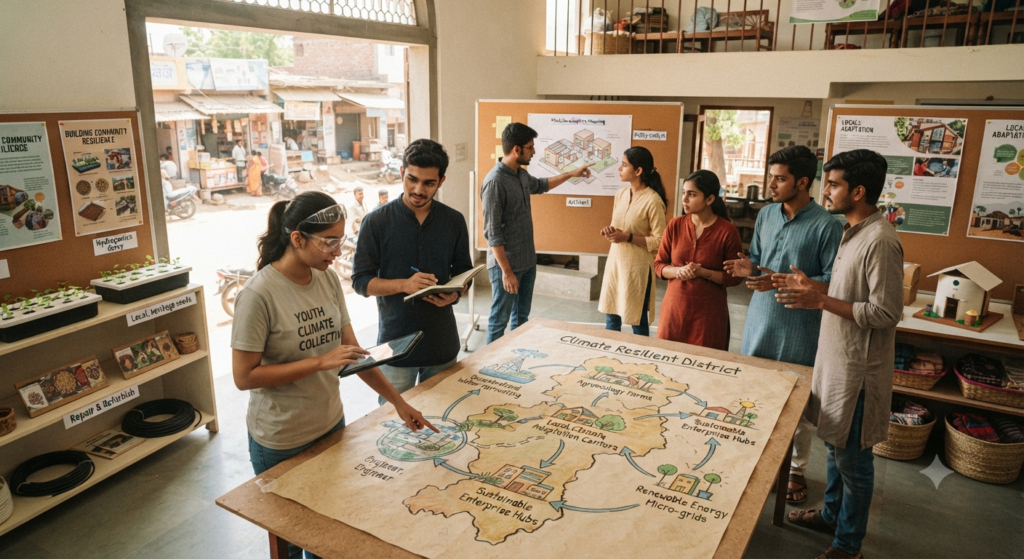
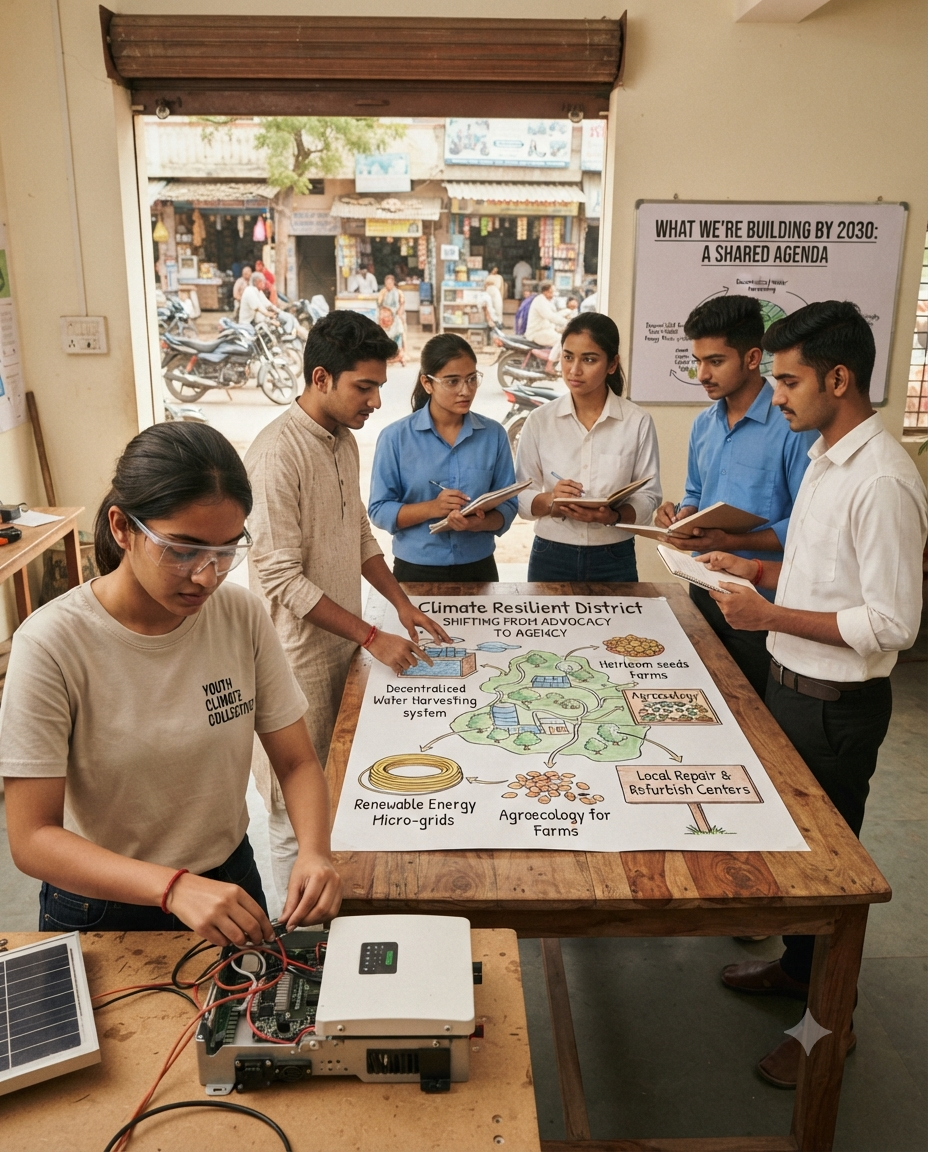
One of the biggest lessons from my work in the circular economy is that opportunities need to exist where people actually live. Every young person shouldn’t have to pack their bags and move to a metro city just to learn a skill, find a job, or start a business. We need local, community-rooted ecosystems where people can learn, work, and build enterprises right in their own towns and districts.
In practice, that looks like:
- Neighbourhood repair and refurbishment centres that create skilled jobs while keeping products in use longer.
- Community-run waste and resource recovery businesses that offer safer, formal alternatives to informal waste picking.
- Local teams installing and maintaining decentralised solar, battery storage, and energy-efficiency systems.
- Hyper-local services focused on rainwater harvesting, cooling, and heat resilience.
- Young entrepreneurs turning local environmental challenges into viable small businesses.
- Distributed professional opportunities in technology, design, research, consulting and digital services, allowing young people to build meaningful careers without having to migrate to major cities.
At the same time, bringing work closer to home means little if the jobs themselves aren’t safe, dignified or fairly paid. This applies to both blue-collar and white-collar workers. While technicians, farmers, sanitation staff, construction workers and informal waste workers face direct exposure to extreme heat and hazardous conditions, office workers and professionals are also navigating rising living costs, longer commutes, urban heat, insecure employment and growing pressures on their well-being.
A truly “just transition” means safer workplaces, fair wages, social security, better working conditions and clear pathways for people across occupations to develop skills, advance their careers and participate in the emerging green economy.
A shared agenda instead of another silo
Instead of launching yet another standalone youth climate programme, we need to bring existing networks, grassroots groups, startups, and institutions together around one integrated game plan.
| Priority | What we need to do together |
| Youth and jobs | Build clear pathways from climate skills to decent jobs and small businesses |
| Circular economy | Grow local repair, reuse, recycling, and material recovery & reuse networks |
| Climate adaptation | Put community-level systems in place to handle extreme heat and water stress |
| Worker dignity | Create avenues for intergenerational dialogues for safer working conditions, protective gear, and social security of youth |
| Climate Tech | Make climate solutions, appropriate technologies and practical innovation accessible to communities and young people |
| Policy and accountability | Turn broad climate pledges into tracked, measurable results at the local level |
The biggest strength of India’s youth movement is how diverse it is. National networks, regional groups, campus collectives, and young founders all bring something different to the table. We shouldn’t try to force everyone under a single logo or organisation. Instead, we should align around a shared agenda – one with clear priorities, complementary roles, and real accountability.
Practically, as youth, our focus should be to:
-
Connect: Bring youth networks, grassroots groups, businesses, institutions, and policymakers into the same room.
-
Demonstrate: Build working, community-level models for circular livelihoods and climate resilience.
-
Influence: Take real data and lessons from the ground back to policymakers.
-
Scale: Help replicate what works across different districts and states.
We simply cannot afford another decade of talking about climate change without building real solutions. Since 2006, youth climate work in India has grown up. Our priorities have shifted, our skills have sharpened, and the crisis is right at our doorstep. We have spent years raising awareness, building networks, and demanding action from leaders. Now it is time to put all that hard-won experience to work.
We don’t need to walk away from COP, but we have to stop letting global summits dictate when we start and stop acting. We don’t need another competing movement fighting for the spotlight; we need a coalition that turns what we already have into real results on the ground. It is time to shift from advocacy to agency, from scattered projects to collective muscle, and from global promises to local livelihoods.
